



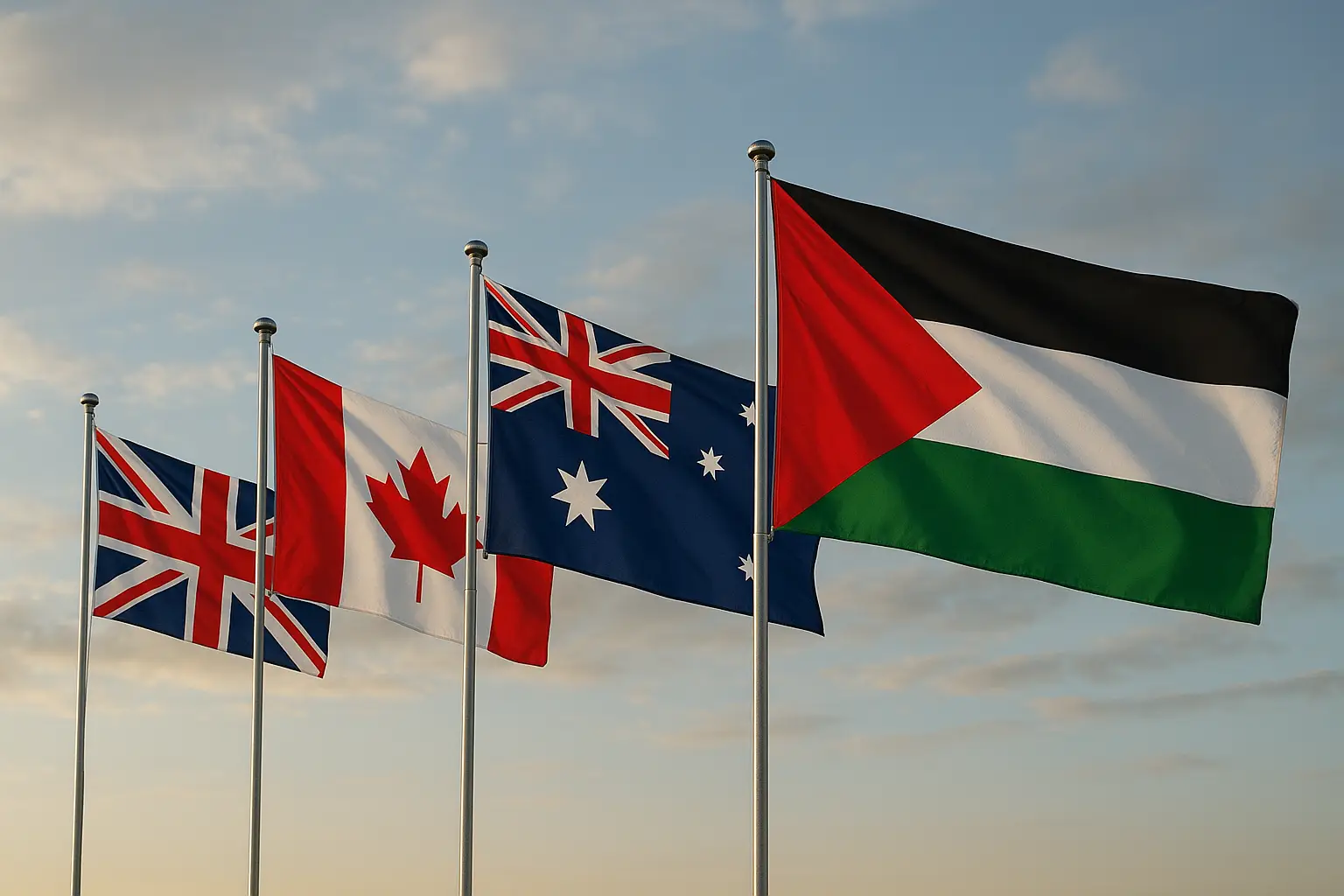
- The recognition of the Palestinian state by the United Kingdom, Canada, and Australia on September 21, 2025, marks a major turning point in international diplomacy. This policy shift realigns these nations with the more than 140 states that already acknowledge Palestinian statehood.
UK Prime Minister Keir Starmer declared that the move is meant “to keep alive the possibility of peace and a two-state solution, that means a safe and secure Israel alongside a viable Palestinian state.”
Canada, led by Prime Minister Mark Carney, echoed a similar sentiment: recognising Palestine and offering partnership to build a peaceful future for both Palestinians and Israelis.
Likewise, Australia under PM Anthony Albanese formalised recognition in a joint statement with Foreign Minister Penny Wong. Their declaration stressed immediate priorities: a ceasefire in Gaza, the release of hostages, and that Hamas must not be part of future governance.
Global Reactions: From Approval to Strong Rejection
Palestinian Response
The Palestinian leadership welcomed the recognition as “historic,” framing it as an irreversible stride toward independence, sovereignty, and the preservation of the two-state solution idea. Palestinian Foreign Minister Varsen Aghabekian Shahin emphasised that while recognition may not end conflict immediately, it’s a “move forward to build on and amplify.”
Israeli Opposition
The response from Israel was sharply critical. Prime Minister Benjamin Netanyahu accused the recognising countries of “rewarding terror,” especially in light of the October 7 attack by Hamas. He reaffirmed that there will be no Palestinian state “to the west of the Jordan River.”
Israel’s objections also include arguments that statehood must be the product of direct negotiations rather than unilateral recognition.
What This Means in the Larger Context
Two-State Solution Revisited
The recognition comes amid increased international pressure to revive a two-state solution — a framework long endorsed by many countries but stalled by conflict, disagreements over territory, settlements, and governance.
By formally recognising Palestine, the UK, Canada, and Australia are insisting that a viable future for both Israelis and Palestinians must include statehood and security guarantees.
Shifts in Diplomacy
This move marks a departure from the traditional alignment of these nations, particularly concerning their relations with the United States and Israel. It signals a willingness to act independently in foreign policy when human rights, humanitarian concerns, and long-term peace are at stake.
Challenges Ahead
- Achieving peace on the ground remains uncertain. Recognition alone cannot resolve issues like Israeli settlements, the status of Jerusalem, security, or borders.
- Political pushback from Israel and its allies may intensify, possibly affecting diplomatic relations.
- Implementation of conditions (ceasefire, humanitarian access, and excluding Hamas from governance) will require international coordination and strong monitoring mechanisms.
- Achieving peace on the ground remains uncertain. Recognition alone cannot resolve issues like Israeli settlements, the status of Jerusalem, security, or borders.




