



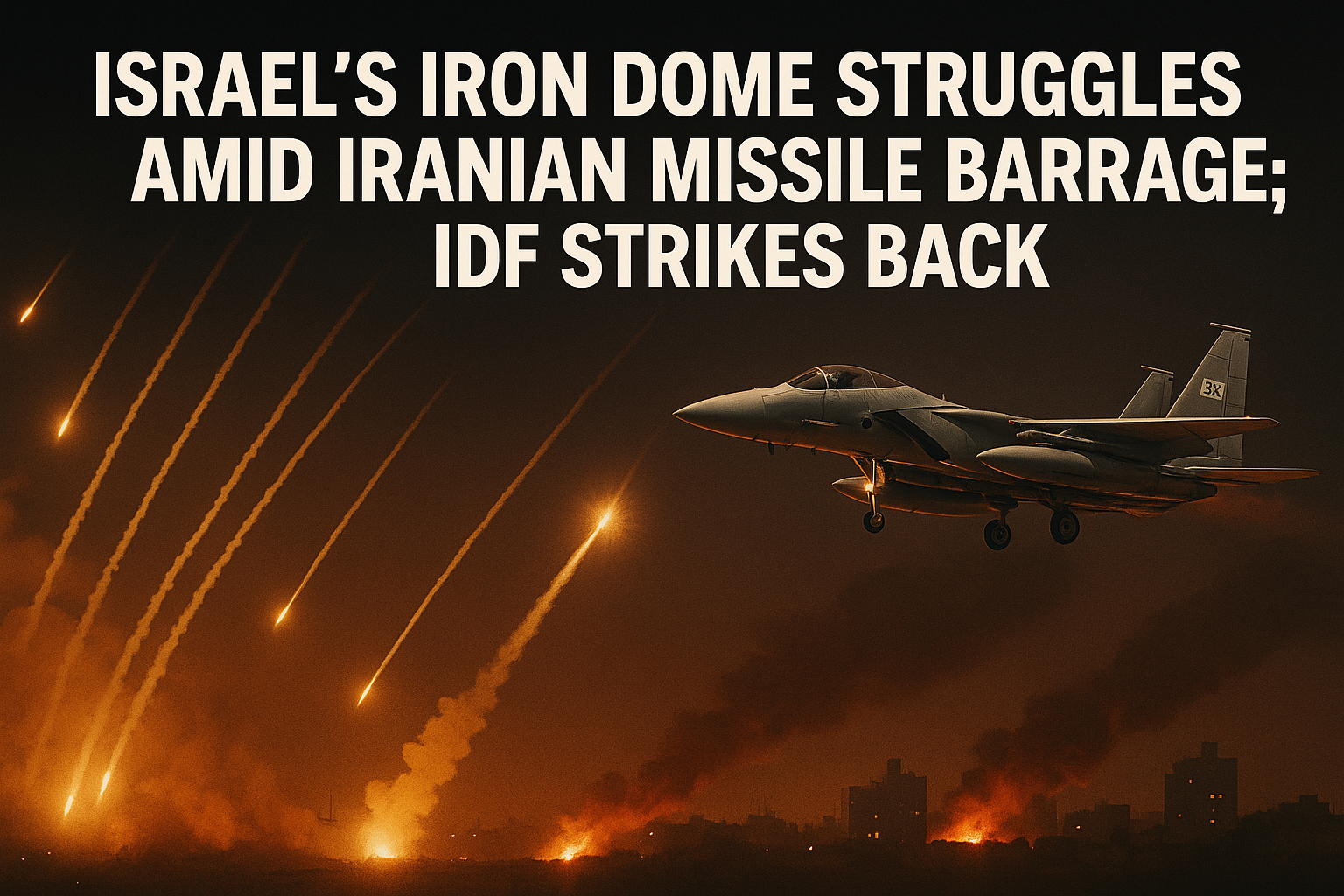
The Israel-Iran conflict escalated sharply as Iran unleashed a large-scale missile and drone barrage, pushing Israel’s Iron Dome defense system to its operational limits. In response, the Israeli Air Force (IAF) launched coordinated strikes deep inside Iran, targeting nuclear-linked and air defense facilities.
Iron Dome Under Strain
Israel’s missile defense system—comprising the Iron Dome, David’s Sling, and Arrow 3—was activated across multiple cities to intercept hundreds of incoming projectiles. While most were neutralized mid-air, a few penetrated the defenses, causing damage in southern and central Israel.
Former Israeli Brigadier-General Amir Avivi acknowledged the pressure:
“The system is working, but no shield is 100% foolproof. Civilian caution is still critical.”
The Iron Dome, designed to counter short-range rockets, has now faced sustained attacks from ballistic missiles and drones launched in waves—a scenario for which it was not primarily optimized.
Israel’s Swift Retaliation
In a robust counter-offensive, Israel deployed over 60 fighter jets, striking Iranian positions across multiple provinces, including Isfahan, Tehran, and near suspected nuclear facilities in Arak and Natanz.
According to Israeli media and satellite intelligence:
- Iranian air defense systems were primary targets.
- Strikes also hit missile storage depots, radar installations, and underground command centers.
- Surveillance drones and Mossad-coordinated sabotage were reportedly involved.
Explosions rocked areas around Soroka Hospital and other infrastructure sites, signaling that Iran’s defenses were compromised.
Israel’s Iron Dome, though effective, is under extreme operational pressure as missile barrages from Iran test its endurance. With Israeli airstrikes now targeting key Iranian military assets, both nations are engaged in one of the most volatile standoffs in recent history. Whether this marks the beginning of prolonged conflict or a strategic recalibration remains to be seen.




