



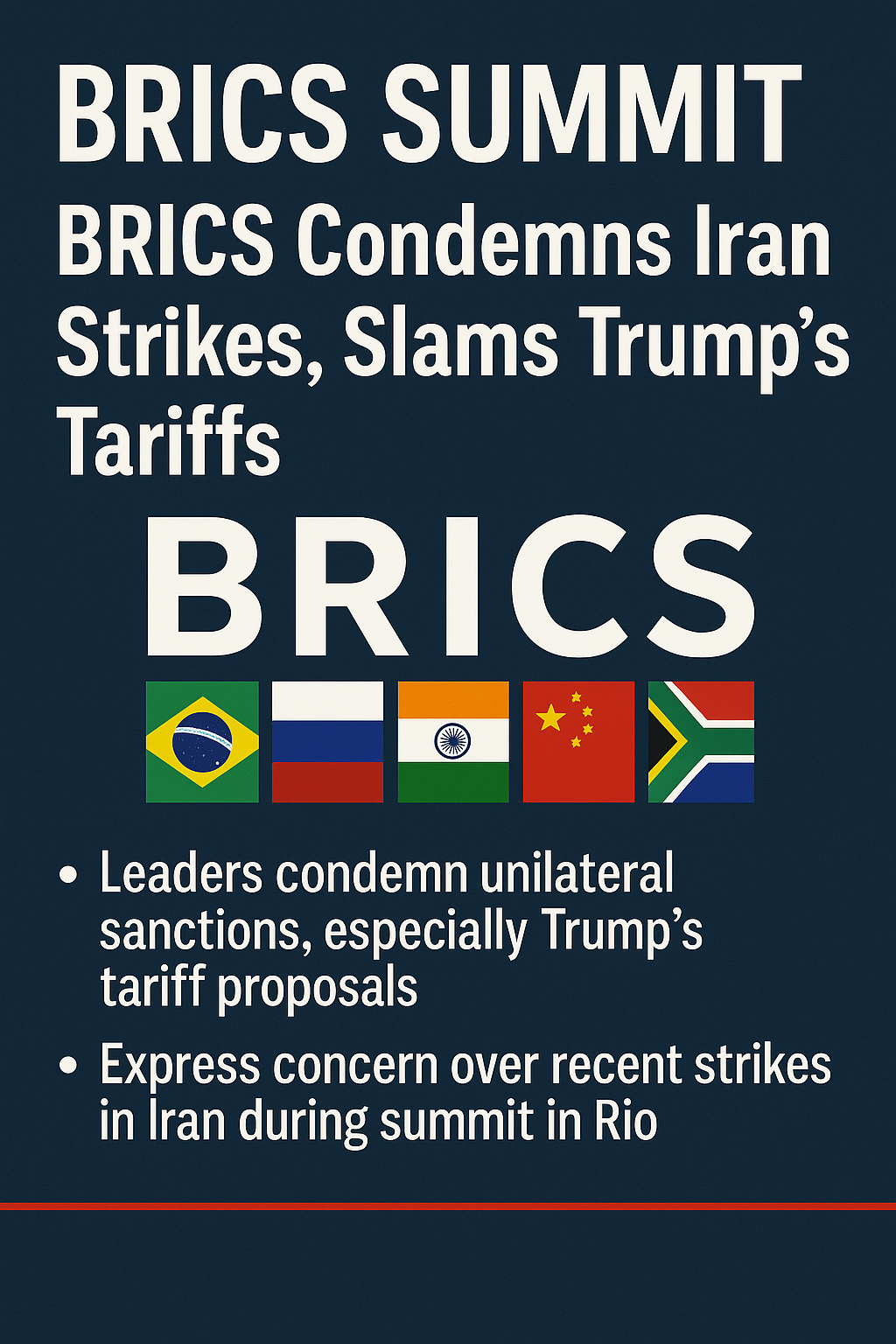
At the latest BRICS summit held in Rio de Janeiro, member nations issued a strong statement condemning unilateral actions, particularly targeting recent US policies under former President Donald Trump. The group also voiced unified concern over the escalating conflict in the Middle East, criticizing the recent airstrikes on Iran.
The summit, which brought together leaders from Brazil, Russia, India, China (represented by Premier Li Qiang in the absence of President Xi Jinping), and South Africa, marked a pivotal moment of global dissent against US-led economic and military maneuvers.
Trump Tariffs in Spotlight
Central to the discussions was the resurgence of protectionist trade measures, particularly the tariffs proposed by former US President Donald Trump, who is once again seeking the White House in 2024. Trump’s remarks about reinstating sweeping tariffs on imports — especially those targeting China and emerging economies — drew sharp responses.
The BRICS leaders jointly decried such trade practices as “unilateral, coercive, and detrimental to global economic recovery.” Brazil’s President Luiz Inácio Lula da Silva warned, “Tariff wars and sanctions only deepen global divides and hurt the world’s poorest.”
China’s Premier Li Qiang, stepping in for President Xi Jinping who was notably absent, echoed the sentiment, urging for multilateral trade to replace punitive economic tactics. Xi’s absence, the first in BRICS history, sparked speculation, though Beijing attributed it to “scheduling conflicts.”
Iran-Israel Tensions Condemned
The summit also addressed growing instability in the Middle East. A joint statement condemned recent strikes on Iranian soil, which BRICS leaders described as “a violation of international law and territorial sovereignty.”
South African President Cyril Ramaphosa emphasized the risk of escalating conflicts without a global consensus. “We must resist returning to a world where force dictates diplomacy,” he said, referencing both the Iran attacks and ongoing hostilities in Gaza.
India, while taking a more measured stance, reiterated the need for peaceful dialogue and regional stability. Prime Minister Narendra Modi underscored that “conflict anywhere impacts global peace everywhere.”
Push for Global South Unity
Beyond critiques of Western policy, the summit also called for reform of international institutions, including the United Nations Security Council and global financial systems. The leaders advocated for stronger representation of the Global South, particularly in the wake of rising geopolitical tensions.
The Rio summit showcased BRICS’ intent to position itself as a counterbalance to US influence, with proposals for increased intra-BRICS trade, cross-border payment systems, and alternatives to the dollar-dominated financial order.
As the world grapples with economic fragmentation, the BRICS bloc — now expanded to include more developing economies — is asserting itself not only as an economic force but also as a political alliance seeking a multipolar world.




