



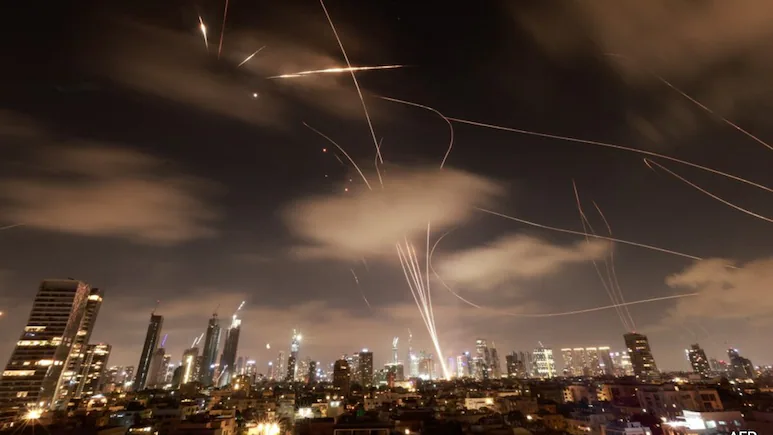
The already intense Israel–Iran air war took a high-tech turn today, with Iran’s Islamic Revolutionary Guard Corps (IRGC) firing the newly unveiled Fattah‑1 hypersonic missile toward Israel. Meanwhile, former U.S. President Donald Trump demanded Iran’s “unconditional surrender,” marking a sharp escalation in both military and political rhetoric.
Debut Deployment of Fattah‑1
- Hypersonic capability: The Fattah‑1, unveiled in 2023, reportedly travels at Mach 13–15 (15,800–18,000 km/h), carries a 350–450 kg warhead, and incorporates mid-course maneuverability, designed to evade missile defenses like Iron Dome and Arrow.
- Range and design: With a range of around 1,400 km and precision-guided reentry capabilities, the missile can penetrate deep inside Israel. Its operational debut tested these limits during “Operation True Promise III.”
- Shockwaves over Tel Aviv: Iranian state media claim the missiles “shook shelters” across Tel Aviv in their eleventh wave of nocturnal attacks.
Israel’s Retaliation and Civilian Impact
- Massive air response: Israeli forces responded with 60 fighter jets, targeting critical infrastructure in Tehran — nuclear sites, missile bases, and military academies.
- Rising toll: Casualties now include 224 dead and over 1,000 injured in Iran; 24 civilians killed and hundreds wounded in Israel. Thousands of residents are fleeing Tehran to neighboring countries.
- Defense strain: Continued hypersonic attacks are testing Israel’s missile-defense reserves, prompting additional U.S. deployment to the region.
Trump’s “Surrender” Demand and Global Tension
- Unprecedented rhetoric: Speaking on Truth Social, Trump backed massive air support for Israel and urged Iran to surrender unconditionally, asserting he “knows Khamenei’s location.” He justified his stance by warning Iran faces only one choice — submission.
- Tehran’s response: Iran’s Supreme Leader Ayatollah Khamenei declared that “the battle begins,” warning that any direct U.S. or Israeli intervention could ignite a broader war.
Strategic Ramifications
- Eroding Air-Defensive Edge: The deployment of hypersonic missiles may render current defense technologies less effective, prompting urgent technical reviews.
- Escalation Risk: Trump’s interventionist tone raises the stakes, potentially drawing the U.S. deeper into the conflict, though critics argue it risks triggering a larger regional war.
- Humanitarian Urgency: With civilian casualties mounting and evacuations underway, international mediation is becoming critical to preventing a wider crisis.
The introduction of the Fattah‑1 hypersonic missile marks a dangerous progression in the Israel–Iran air war, both technologically and politically. With Trump demanding Iran’s surrender and both nations mobilizing airpower, avoidable missteps could immediately escalate this into a full-blown regional war. Watching defence responses, political signaling, and humanitarian efforts is now more crucial than ever.




