



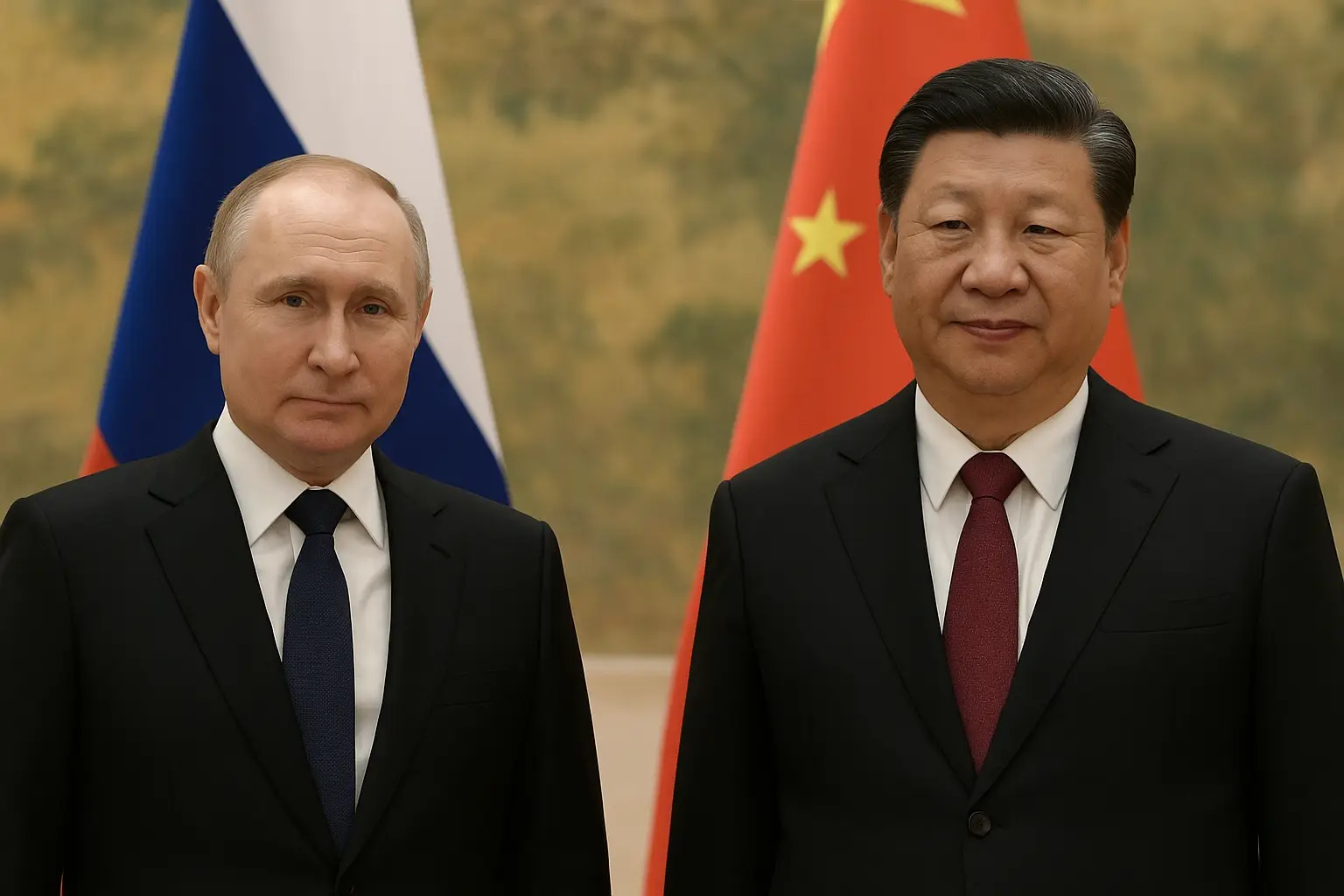
- Russia and China reaffirmed their commitment to closer cooperation within the BRICS bloc, with Russian President Vladimir Putin calling Chinese President Xi Jinping a “great leader” during recent high-level talks. The remarks came amid the Shanghai Cooperation Organization (SCO) summit, highlighting the growing strategic alignment between the two powers as they push back against what they describe as “discriminatory sanctions” from Western nations.The renewed partnership signals not only a deeper Russia-China bond but also a shared vision to expand BRICS influence on the global stage, particularly in trade, finance, and diplomacy.
Putin and Xi Showcase Unity at SCO Summit
At the SCO summit, held in Kazakhstan, Putin and Xi were seen engaging in a cordial one-minute conversation that underscored their personal rapport. Their interaction was widely interpreted as symbolic of the broader geopolitical cooperation between Moscow and Beijing.
Putin lauded Xi as a “great leader,” emphasizing China’s critical role in shaping the BRICS agenda. He stressed that Moscow and Beijing would continue to collaborate in opposing what they view as unfair restrictions imposed by Western governments on BRICS economies.
Opposition to Western Sanctions
Both Russia and China have consistently criticized sanctions imposed by the United States and its allies, particularly those targeting Russia following its invasion of Ukraine. During his remarks, Putin reiterated that such measures are “discriminatory” and undermine global trade stability.
Xi Jinping echoed similar sentiments in earlier statements, stressing the importance of building alternative frameworks for trade and financial systems. With BRICS expanding to include new members such as Saudi Arabia, the UAE, and Egypt, the bloc is increasingly positioning itself as a counterbalance to Western-dominated institutions like the G7 and IMF.
BRICS Expansion and Strategic Goals
The BRICS group — originally comprising Brazil, Russia, India, China, and South Africa — has steadily grown in influence over the past decade. The recent expansion to include Middle Eastern and African nations reflects the bloc’s ambition to diversify its economic partnerships and increase bargaining power in global markets.
For Russia, closer ties with China provide an essential lifeline as Western sanctions continue to strain its economy. Meanwhile, Beijing views Moscow as a critical ally in reshaping global governance structures and reducing reliance on U.S.-led frameworks.
Global Implications
Analysts suggest that the strengthened Russia-China partnership within BRICS could reshape economic and political alignments. By advocating for a multipolar world, both nations aim to amplify the voice of emerging economies and reduce dependency on Western financial systems.
However, Western nations remain skeptical of the bloc’s capacity to provide a genuine alternative. Concerns also persist about whether internal differences among BRICS members might slow progress on key initiatives.
Still, the symbolic unity displayed by Putin and Xi at the SCO summit sends a clear message: Russia and China intend to play a central role in steering BRICS toward greater global relevance.




