



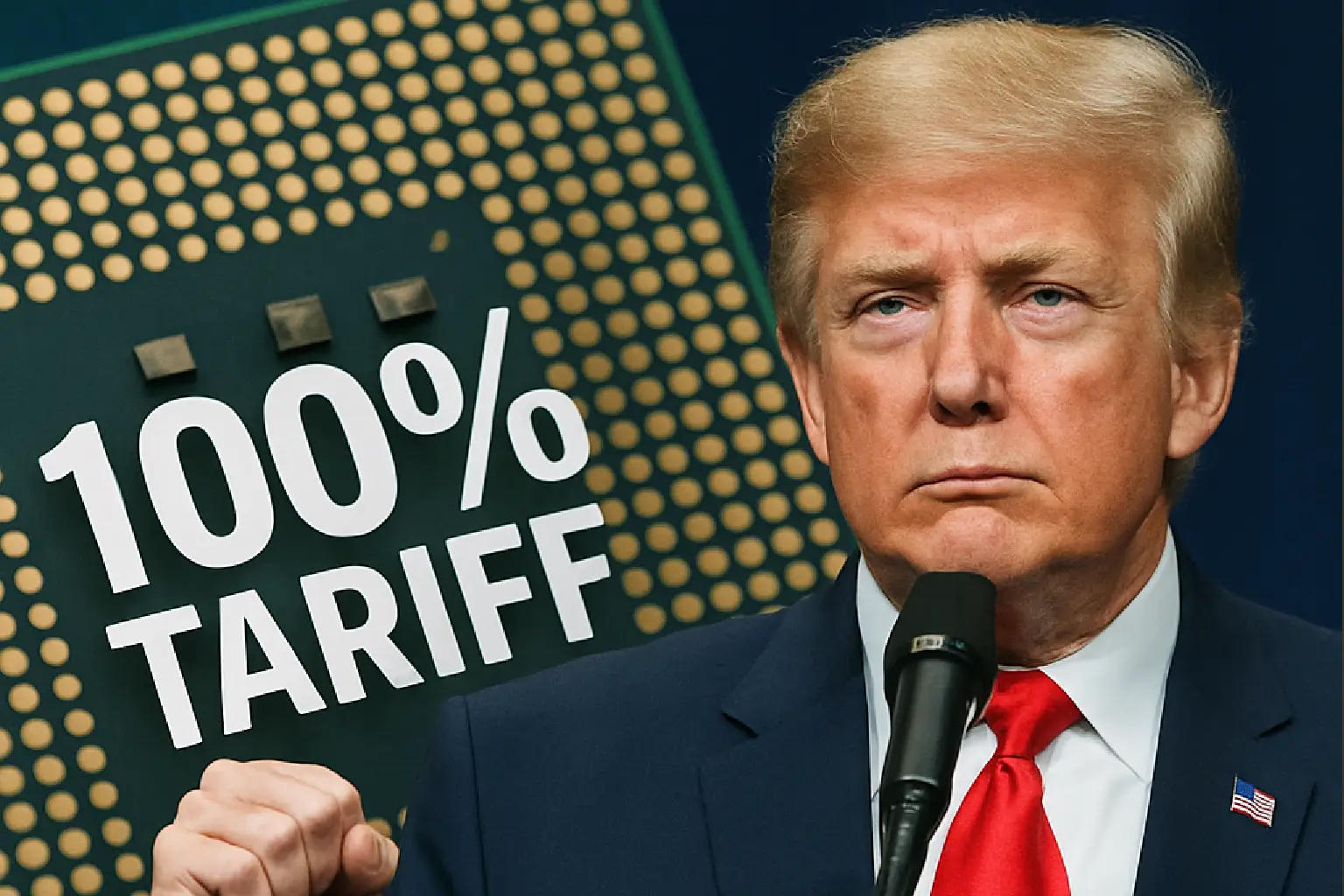
In a significant escalation of U.S. trade policy, President Donald Trump unveiled a sweeping 100% tariff on imported semiconductor chips on August 6, 2025—while granting exemptions to companies that commit to investing in domestic manufacturing, notably Apple. The announcement was made during a White House event featuring Apple CEO Tim Cook, who emphasized the company’s substantial U.S. investment pledge.
Under the new tariff policy, foreign-made chips and semiconductors will face punitive duties unless the importing firms either already manufacture in the U.S. or have committed to building American production facilities. Apple secured exemption status through its pledge to invest approximately $600 billion in U.S. manufacturing and supply chains—a commitment symbolically represented through domestic production partnerships like Corning’s Kentucky glass facility.
This aggressive tariff strategy is designed to accelerate domestic semiconductor production under Trump’s “America First” economic agenda. However, its enforceability and economic impact remain debated. Critics question whether this tariff will serve as a genuine incentive or simply a punitive threat, especially given the policy’s flexible exemption structure and lack of clarity around investment thresholds.
Apple’s exemption follows a high-profile Oval Office visit, during which CEO Tim Cook presented Trump with a personalized gold-and-glass sculpture—both a symbolic gesture and a diplomatic overture aimed at shielding the tech giant from tariffs that could disrupt its global supply chain.
Markets responded positively to Apple’s announcement. The company’s share price rose more than 5%, reflecting investor confidence in the tariff exemption and continued growth in U.S. manufacturing prospects.
The broader implications of this tariff announcement are significant. Other tech firms—including Nvidia and others—are expected to evaluate their own U.S. investment plans in light of the policy’s flexible exemption model. This could spur a wave of domestic capital allocations, though some may merely reframe existing programs to meet the policy’s wording.
Still, a degree of uncertainty clouds the policy’s rollout. Observers note that many announced investment plans predate Trump’s re-election and the exemption criteria are vague. The absence of defined timelines or enforcement mechanisms raises questions about whether the tariffs will be implemented as threatened or remain largely symbolic.
This tariff follows Trump’s recent expansion of “reciprocal” tariffs across various sectors, reinforcing his administration’s commitment to restructuring global trade relationships with aggressive domestic incentives.
President Trump’s new 100% semiconductor import tariff signals a bold move to domesticate America’s tech supply chain—but its real-world impact may depend heavily on how companies navigate the exemptions and whether Trump’s incentives translate into actual U.S. manufacturing growth.




