



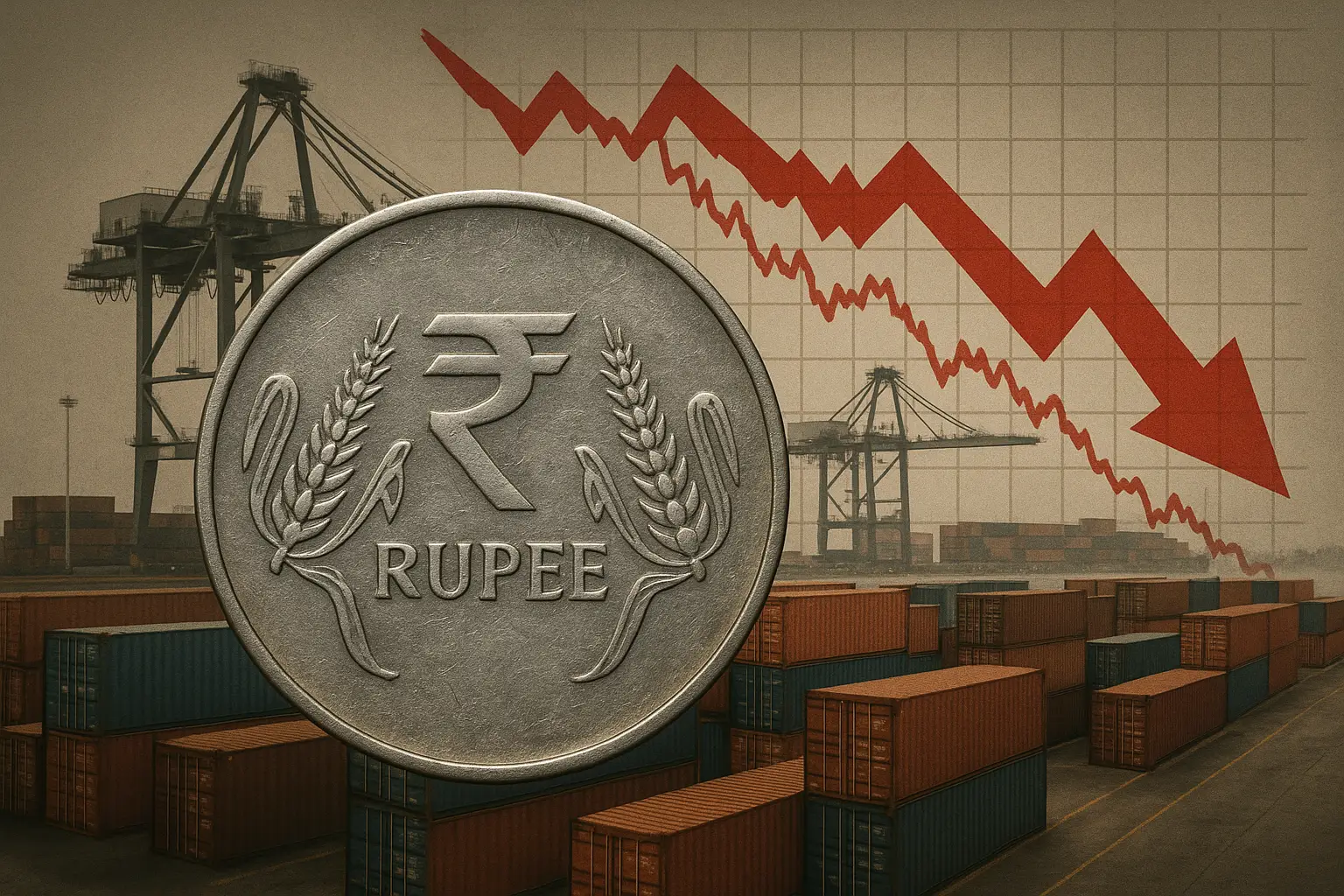
The Indian rupee hit a record low of 87.70 against the US dollar on Tuesday, falling 52 paise in a single session as Donald Trump’s renewed tariff threats rattled investor confidence and triggered heavy foreign outflows.
The decline marked the rupee’s sharpest single-day fall in two months, driven by global risk aversion and concerns over India’s trade relations with the United States. Earlier in the day, the currency opened 20 paise lower at 87.38 and continued to slide amid volatile market conditions.
Tariff Threats Pressure Currency
The latest pressure on the rupee comes after US President Donald Trump signaled steeper tariffs on Indian exports if trade negotiations do not progress swiftly. The comments sparked fears of heightened trade tensions, adding to the volatility in equity and currency markets.
“Foreign investors are reducing their exposure due to uncertainty over India-US trade talks, and the dollar’s strength is putting additional pressure on the rupee,” said Ravi Kumar, a senior forex analyst at a Mumbai-based brokerage.
Global Factors Weigh on Markets
The rupee’s fall was compounded by:
- Rising US Treasury yields boosted the dollar index.
- Continued selling by foreign portfolio investors (FPIs) in Indian equities.
- Safe-haven demand for the dollar amid escalating global trade tensions.
Meanwhile, crude oil prices remained stable, offering little relief to India’s import-heavy economy, which is highly sensitive to energy costs.
Market Reaction and RBI Outlook
Domestic equity markets mirrored the currency volatility, with the Sensex falling over 300 points intraday before recovering some losses. Analysts suggest the Reserve Bank of India (RBI) may consider intervention if the rupee breaches 88 per dollar, although the central bank has so far allowed market-driven movement.
“While the RBI has adequate forex reserves to stabilize the currency, it may choose to act selectively to curb extreme volatility rather than defend a particular level,” said Meera Shah, an economist at a private bank.
Traders expect the rupee to remain under short-term pressure until there is more clarity on trade negotiations with the US. A favorable outcome or easing of tariff threats could help the currency recover, while any escalation may push the rupee closer to 88.
Exporters, particularly in the IT and textile sectors, are expected to benefit from the weaker rupee, while importers and sectors reliant on foreign components could face higher costs if the slide continues.




