



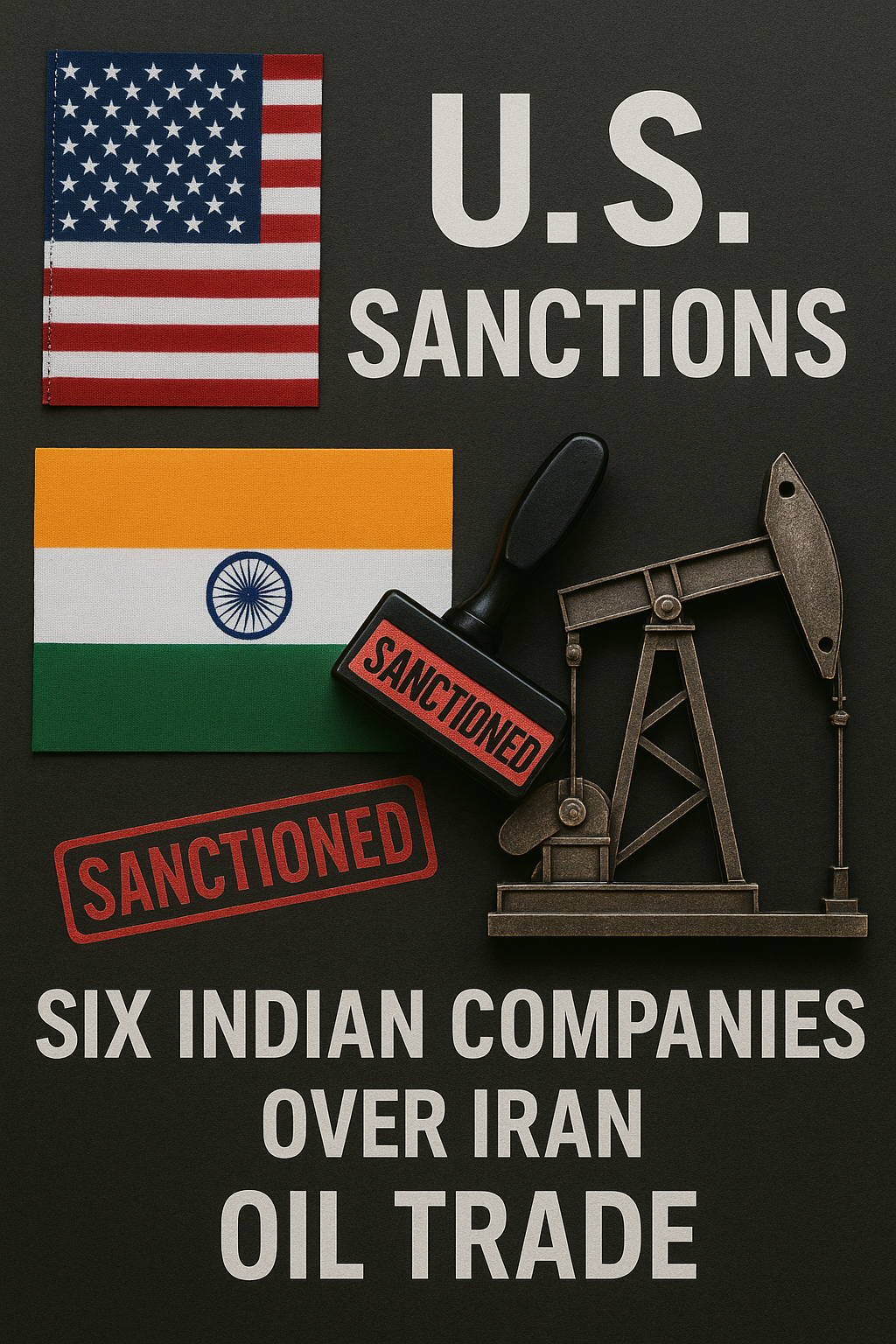
The United States has imposed sanctions on six Indian companies for allegedly purchasing and transporting Iranian petroleum, citing violations of international energy restrictions. The move marks a rare friction point in U.S.-India relations amid ongoing cooperation in trade and defense.
The sanctioned firms are accused of engaging in transactions that support Iran’s oil export network, which Washington continues to target under its long-standing sanctions on Tehran. While the U.S. did not disclose the exact volume of crude involved, it indicated that the actions fall under the Countering America’s Adversaries Through Sanctions Act (CAATSA).
Sanctions Not Meant to Punish India
U.S. State Department spokesperson Emily Harris emphasized that the sanctions are “not intended to punish India or harm bilateral relations”, but to maintain pressure on Iran’s energy sector.
“India remains an important strategic partner, but we expect all countries to adhere to our sanctions framework regarding Iranian oil,” Harris said in a press briefing.
The sanctioned Indian companies will face asset freezes under U.S. jurisdiction and restrictions on dollar-based transactions, though humanitarian trade exemptions remain in place.
Indian Government Responds
New Delhi acknowledged the sanctions and said it would review the allegations before taking any further steps. Officials reiterated India’s commitment to energy diversification, noting that Iranian imports have significantly decreased in recent years due to geopolitical constraints.
A senior Ministry of External Affairs official, speaking on condition of anonymity, stated:
“We have conveyed our concerns to the U.S. that Indian companies act within the law. We will continue our dialogue to protect India’s energy security and trade interests.”
Impact on Trade and Energy
The sanctions could create short-term challenges for affected companies, particularly in processing dollar transactions and accessing international shipping insurance. However, experts believe the broader India-U.S. economic relationship will remain resilient.
“Both nations are aware of their strategic interdependence,” said energy analyst Priya Menon. “This is likely a cautionary move from Washington, not a signal of deteriorating ties.”
India, the world’s third-largest oil importer, has been gradually reducing reliance on Iranian crude since 2019, turning instead to suppliers in the Middle East, the U.S., and Russia.
Geopolitical Context
The sanctions come at a sensitive moment, as the U.S. seeks to balance pressure on Iran with its growing partnership with India to counter China’s influence in the Indo-Pacific.
Analysts suggest that the move highlights Washington’s zero-tolerance approach to Iranian oil trade, even as it pursues broader cooperation with New Delhi in defense, technology, and energy.




