



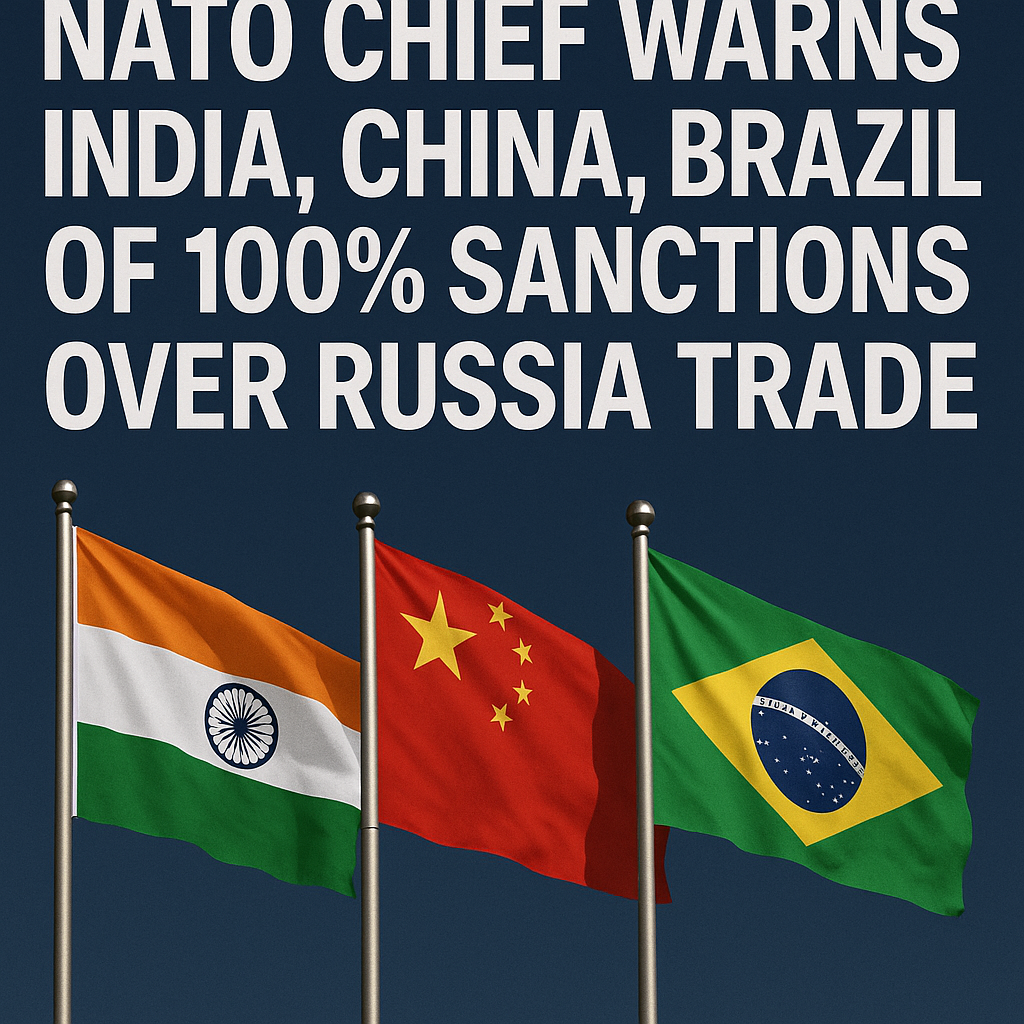
A day after former U.S. President Donald Trump issued a 50-day deadline to Russia to broker peace with Ukraine, NATO Secretary-General Mark Rutte has escalated global pressure by warning India, China, and Brazil of potential 100% secondary sanctions if they continue significant trade ties with Moscow.
Rutte urged the three countries to “make the call” to Russian President Vladimir Putin and support efforts to end the war in Ukraine. The threat comes as NATO allies align behind a unified strategy to isolate Russia economically and politically until a peace agreement is reached.
NATO’s 100% Tariff Warning
The proposed sanctions would target third-party nations continuing to trade with Russia, particularly in energy, defense, and strategic commodities. Rutte stated that if nations like India, China, and Brazil do not take a firm stance or reduce their economic engagement with Russia, they could face tariffs of up to 100% on trade with NATO members.
“This is not a regional conflict. The world must speak with one voice,” said Rutte during a press conference in Brussels.
He emphasized that neutral or non-aligned countries “cannot benefit from global markets while funding war through indirect support.”
India in the Crosshairs
India, which has significantly increased oil imports from Russia since the start of the Ukraine war, is now under intense scrutiny. Indian officials have thus far maintained a policy of strategic autonomy, refraining from taking sides while advocating for peace and dialogue.
While New Delhi has not issued an official response to Rutte’s comments, diplomatic sources suggest India is closely monitoring the shifting geopolitical winds and will evaluate trade risks carefully.
India’s foreign policy experts have warned that blanket secondary sanctions could disrupt energy supplies, spike inflation, and harm fragile post-pandemic economic recovery.
China and Brazil Also Targeted
China, Russia’s largest trade partner, and Brazil, a key agricultural exporter to Moscow, were also specifically mentioned by NATO. Beijing is expected to resist Western pressure, while Brazil’s response under President Luiz Inácio Lula da Silva remains uncertain.
“We are not telling these countries what to do, but we are clarifying what the consequences may be,” Rutte added.
A Shift Toward Economic Enforcement
The NATO chief’s remarks indicate a broader move toward economic enforcement tools—tariffs and sanctions—rather than direct military engagement. It follows Trump’s earlier ultimatum, which threatened 100% tariffs on nations buying Russian oil if peace talks fail within 50 days.
Together, the NATO and U.S. approaches represent the most coordinated economic warning yet aimed at curbing global support for Russia’s war machinery.




