



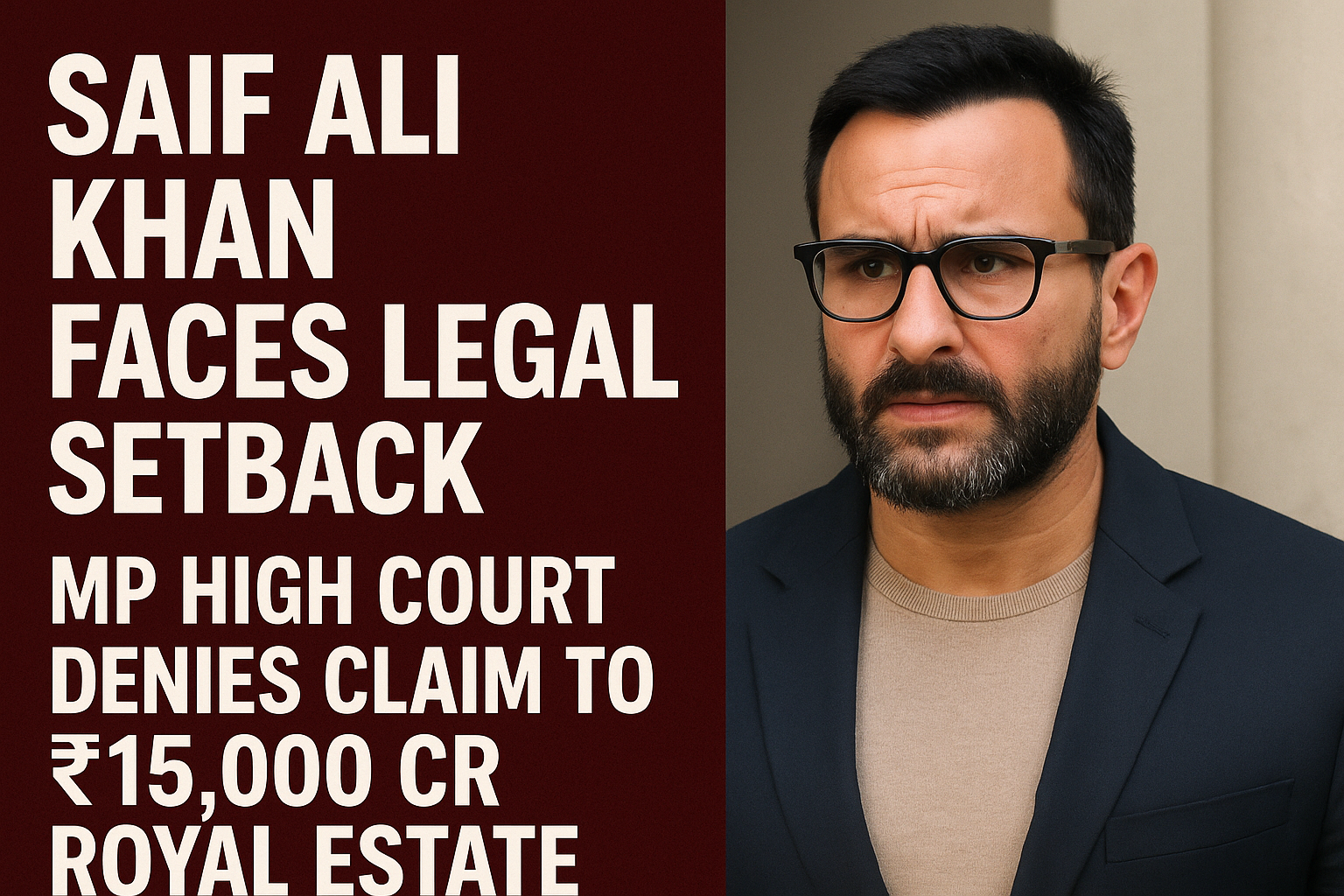
Bollywood actor Saif Ali Khan, the Nawab of Pataudi, has suffered a major legal blow after the Madhya Pradesh High Court set aside an earlier order that allowed him to claim a portion of the ₹15,000 crore royal property in Bhopal.
The court has now ruled that the property in question is classified as “enemy property”, meaning it legally belongs to the Indian government and cannot be inherited by descendants of former royals if their ancestors migrated to Pakistan during or after the Partition.
What Is Enemy Property?
Under the Enemy Property Act, 1968, any property owned by individuals who migrated to Pakistan or China during times of conflict is vested with the Custodian of Enemy Property for India. The law prevents heirs from laying claim to such properties—even if they are Indian citizens—if the original owner was considered an “enemy” under the Act.
Background: The Pataudi Estate Dispute
The estate in question includes vast land holdings and palaces once under the control of the former princely state of Bhopal, with historical ties to the Nawab of Pataudi family. Saif Ali Khan, being the son of late cricketer and Nawab Mansoor Ali Khan Pataudi, was attempting to reclaim inheritance rights over the family assets, arguing that the properties were ancestral and not enemy property.
However, legal complexities surrounding his great-granduncle Hamidullah Khan, who was the last ruling Nawab of Bhopal and whose daughter Abida Sultan moved to Pakistan in 1950, led to the classification of the assets as enemy property.
Court’s Observations
The MP High Court set aside the lower court’s decision from 2023, which had favored Saif Ali Khan. It emphasized that no inheritance can be granted over property designated as “enemy property” under Indian law. The judgment is consistent with the central government’s stance on assets left behind by those who accepted Pakistani citizenship after the Partition.
What This Means for Saif Ali Khan
This ruling effectively blocks any future legal claim by Saif Ali Khan over the massive estate, which includes palaces, land parcels, and royal residences in Bhopal and other regions. While he continues to own private properties and the Pataudi Palace in Haryana, this particular royal inheritance is now out of reach unless the law is amended or overturned in higher courts.




